
C2: Precision & human judgement
Original supported Cambridge-style practice for teacher review.
Study free with your AI
Free content, no account needed. Your AI provider’s own limits and charges apply.
- I can use the lesson language to describe, explain and respond.
Warm-up: Human judgement
When is a fast decision not a good decision? Give an example and explain what a person notices that a machine might miss.
What machines cannot measure
When a town’s last watch repairer retired, the council proposed converting her workshop into a showroom for automated manufacturing. Supporters argued that nostalgia should not obstruct progress. Opponents insisted that the workshop contained something (1) __________ [REPLACE]: not merely a collection of tools, but knowledge acquired through decades of attentive work.
The dispute exposed a weakness in familiar accounts of technological change. The (2) __________ [OBSOLETE] of a tool does not necessarily imply that the judgement developed through using it has become redundant. A machine may reproduce a movement without recognising when that movement is inappropriate.
The council’s preferred measures favoured (3) __________ [STANDARD] and the (4) __________ [REPRODUCE] of results. Both matter, but neither captures the whole value of skilled work. A system that rewards speed can (5) __________ [PROPORTION] disadvantage craftspeople whose contribution lies in noticing unusual faults before they become expensive failures.
Critics of the conversion were not arguing that human expertise was entirely (6) __________ [QUANTIFY]. Rather, they questioned whether the chosen figures measured what the town actually wished to preserve. Technical (7) __________ [DISCERN], they suggested, was valuable precisely because it could distinguish an acceptable shortcut from a damaging compromise.
The eventual proposal paired automated production with apprenticeships in repair. Its aim was not to freeze the town in the past, but to strengthen its (8) __________ [RESILIENT] when new systems failed in unexpected ways.
C2 Word Formation
Form ONE word from the base word. Local exact-answer practice, not a Cambridge score. British standardisation is the stored model; US standardization is valid and needs teacher review, not a claim of automatic acceptance.
- 1.Opponents insisted the workshop contained something [REPLACE].
- 2.The [OBSOLETE] of a tool does not mean human judgement is redundant.
- 3.The council’s preferred measures favoured [STANDARD].
- 4.They also favoured the [REPRODUCE] of results.
- 5.A system rewarding speed can [PROPORTION] disadvantage craftspeople.
- 6.Critics were not arguing human expertise was entirely [QUANTIFY].
- 7.Technical [DISCERN] distinguishes a shortcut from a compromise.
- 8.The town wished to strengthen its [RESILIENT].
C2 Key Word Transformations
Use 3–8 words, including the unchanged key. Avoid contractions. Local correctness only, not official two-mark scoring. Defensible alternatives and realize spelling need teacher review.
- 1.You must never disclose the identity of the interviewee. Key: CIRCUMSTANCES. disclose the identity of the interviewee.
- 2.Without the mediator’s intervention, the negotiations would have collapsed. Key: BEEN. If it the mediator’s intervention, the negotiations would have collapsed.
- 3.Mara objected to the committee’s assumption that speed mattered more than accuracy. Key: ISSUE. Mara assumption that speed mattered more than accuracy.
- 4.The proposal’s approval is far from certain. Key: MEANS. Approval of the proposal conclusion.
- 5.I would prefer you not to mention this disagreement during the presentation. Key: RATHER. I mention this disagreement during the presentation.
- 6.Initially, the researchers had almost no idea how far-reaching their findings would prove to be. Key: LITTLE. Initially, far-reaching their findings would prove to be.
Use & retrieve
In 60–80 words recommend one skill to preserve, using two word families. Write a tactful two-sentence objection to the assumption that faster is better. Later retrieve reproducibility, discernment and resilience when discussing translation.
When should expertise give way to automation?
When should expertise give way to automation?
Format: Speaking, Part 3-inspired long turn and discussion.
Goal: I can sustain a nuanced argument, respond to a counterargument and help develop a shared position.
Important distinction: This is an adapted practice drill. A solo recording or AI partner does not reproduce the official paired examination or demonstrate real peer interaction by itself.
Speaking card A
When should society prioritise human judgement over automated decisions?
You may consider:
- accountability when a decision harms someone;
- consistency versus sensitivity to individual circumstances;
- preserving expertise without resisting useful change.
Speak for about two minutes. Explain a position, qualify it and illustrate it with a concrete example. You do not need specialist technical knowledge.
Partner response
A partner, teacher or clearly labelled AI practice partner responds briefly:
Which distinction in the speaker’s argument was most convincing, and where would you draw the boundary differently?
The speaker then addresses this question:
Could a highly consistent system still be unfair? Why, or why not?
Speaking card B
How can communities preserve expertise without preventing innovation?
You may consider:
- apprenticeships and education;
- the cost of maintaining older skills;
- the difference between cultural value and practical necessity.
Swap roles. The second speaker takes a two-minute turn. The first speaker comments, then both discuss:
- Who should decide which skills deserve public support?
- Can efficiency be measured without deciding whose interests matter most?
- What evidence would make you revise your position?
For paired practice, aim for approximately six minutes of response and discussion around the two long turns. The official Part 3 lasts about ten minutes for a pair; this drill is not an exact script or timed replica.
Optional Czech support
- Vyjádři stanovisko, přidej výhradu a dolož ji příkladem. Nemusíš vyhrát spor.
- Navazuj na partnerův argument: „Rozumím tomu, ale rozlišil bych…“
- Hodnotí se srozumitelnost a práce s jazykem, ne politický názor ani přízvuk sám o sobě.
Useful English starting points, optional in supported practice:
- “The distinction I would draw is between…”
- “That argument is persuasive insofar as…”
- “A possible objection is…, although…”
- “Building on your point,…”
- “I would reconsider that position if…”
Illustrative opening, not a required answer
The distinction I would draw is between decisions that are easy to reverse and decisions that can permanently alter someone’s life. Automation can be valuable when it applies a transparent rule consistently, but consistency is not the same as fairness. Consider a public grant: a system might process applications quickly while overlooking circumstances that the original criteria never anticipated. I would therefore retain a named person who can explain and review the decision, rather than merely endorse whatever the software produces.
Feedback brief for teacher review
Give evidence-based comments on:
- Communicative achievement: Does the learner answer the question, develop a position and qualify claims?
- Language range and control: Are vocabulary and structures varied, precise and used accurately enough to convey the intended distinctions?
- Discourse: Is the argument sustained and coherently organised rather than a list of disconnected points?
- Intelligibility: Can the listener follow the speech, including stress and phrasing? Do not penalise harmless accent differences.
- Interaction: Does the learner engage with the partner’s actual ideas and develop the exchange? Mark this not observed for a solo monologue.
These are LinguaBOOST teaching dimensions, not a reproduction of Cambridge’s official rating scale. Use short comments with quoted evidence; avoid an unsupported Cambridge pass prediction or precise CEFR claim.
Retry: Choose the weakest 20–30 seconds of your answer. Restate it more clearly, then answer one fresh counterquestion without reading a script.
Format source: Official Speaking Part 3 specification: individual two-minute long turns, partner comments and further discussion.
Review & retry
Restate your weakest 20–30 seconds more clearly, then answer a fresh counterquestion without a script. What evidence would make you revise your position?
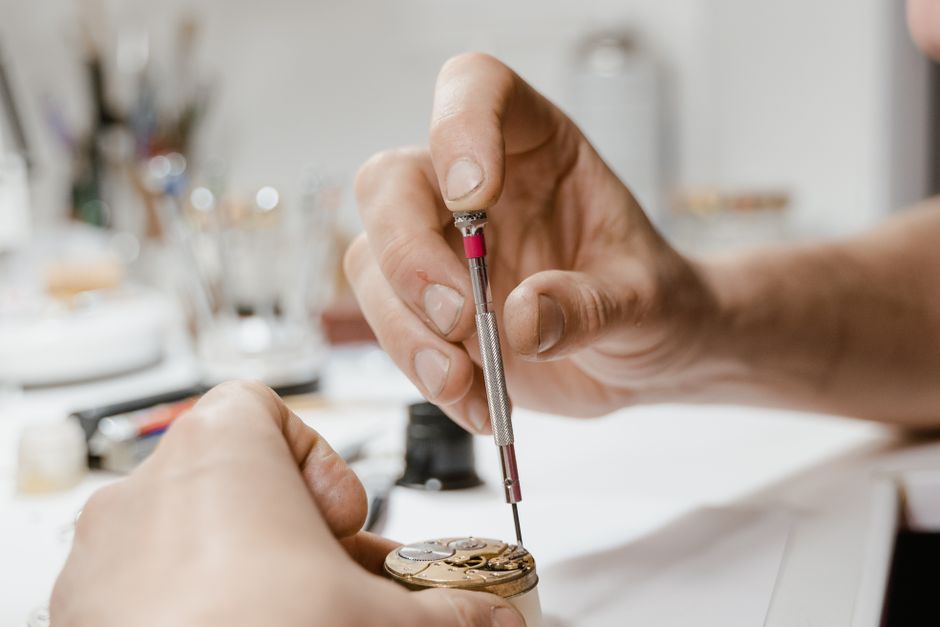
Real watch-repair photograph
Optional authentic video
Official TED upload: https://www.youtube.com/watch?v=t4kyRyKyOpo. Optional enrichment on machine learning, not an exam listening paper. Distinguish a claim in the talk from your own judgement. The original exercises use only the authored passage.
Photo credits
park-benches: betül nur akyürek (Pexels)
red-apples: Andréa Devillier (Pexels)
park-dog: lanzi Jyl (Pexels)
raincoats: Barbara Olsen (Pexels)
puddle: Nothing Ahead (Pexels)
lunchbox: Antoni Shkraba (Pexels)
meeting: Tima Miroshnichenko (Pexels)
watch-repair: Tima Miroshnichenko (Pexels)
Sources & independent practice
Task format reference: Cambridge English C2 Proficiency (CPE). Pre-A1 Starters is below A1; A1 is our catalogue's lowest band, not a claim that Starters is A1.
Passages, pictures, questions and suggested answers are original LinguaBOOST practice. LinguaBOOST is not affiliated with, endorsed by or sponsored by Cambridge University Press & Assessment. This is supported starter practice, not a complete mock examination. Practice feedback is not an official Cambridge result, qualification or pass prediction. A teacher should review answers and age suitability before publication.
Writing Practice
In 60–80 words, recommend one skill your community should preserve. Use two word families from the passage, acknowledge a cost and give a reasoned next step. Then write a tactful two-sentence objection to the idea that faster is always better. Later retry in a different context without rereading. Supported practice, not a complete Cambridge writing paper.
Your own tutor. Your own growth.
Unlock our language-specific tutors, guided feedback and saved progress with a 14-day trial. No card needed.