
Democratizing English learning.
Not just for some. For everyone.
High-impact language training should not be an executive perk. LinguaBOOST equips your entire workforce with 24/7 tutors in their native language, guided learning paths and instant feedback on real speaking and writing, so every employee can qualify for international roles and internal mobility at a fraction of traditional tutoring costs.
Know what English your people actually have.
A verifiable CEFR level, not a CV self-rating.
"Fluent" on a CV means something different to every candidate. LinguaBOOST anchors every employee on the international CEFR scale (A1 to C2) through automated diagnostic placement and ongoing graded production. Hiring, onboarding and promotion decisions rest on objective data you can defend in a performance review.
Every employee is placed on the same international scale, and promotion between bands is calculated from graded work, never from attendance.
Hiring and role fit
A defensible starting level
A CEFR placement test gives each candidate or employee an indicative band before any training spend is committed.
Evidence you can actually hear
Spoken answers are transcribed and scored on pronunciation, fluency, grammar, vocabulary and content, the part a written test never reaches.
Match the level to the job
Set the band a role needs and see who clears it, who is close, and who needs a development plan before the role opens.
Onboarding and development
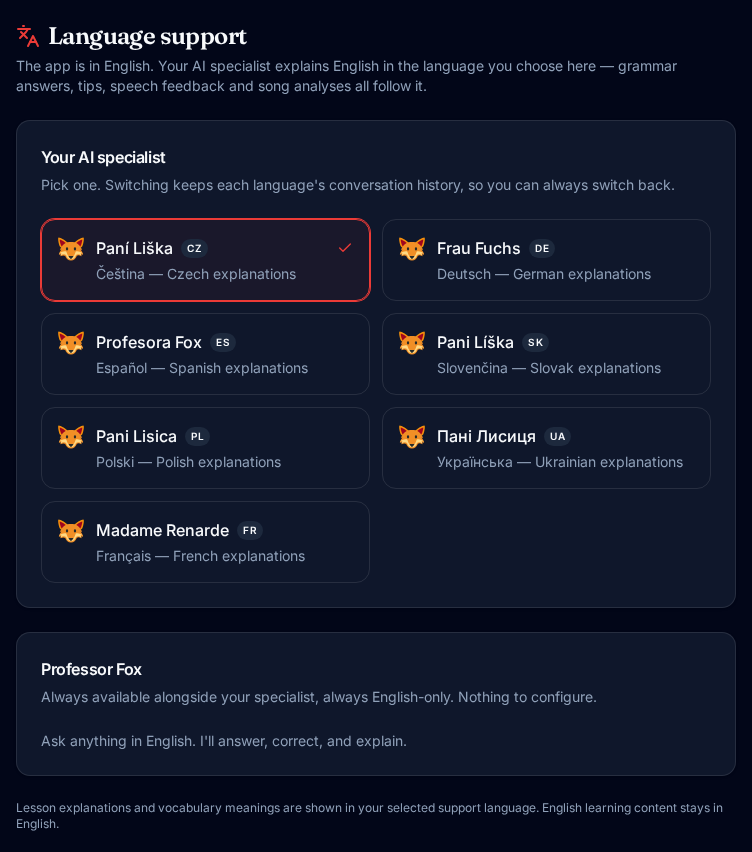
Support in the language they think in
Explanations, hints and translations in Czech, Slovak, Polish, Ukrainian, German or Spanish, so new joiners are not blocked by the language of the help.
Movement, not attendance
Promotion between CEFR levels is calculated automatically from graded results, so progress reporting is not a matter of who logged in.
Something to put in the file
Each person's timeline shows graded work, scores and level changes with dates, a record that survives a performance conversation.
Help in the language they think in.
Czech, Slovak, Polish, Ukrainian, German or Spanish support sits beside every task, so a new joiner is never blocked by the language of the help.
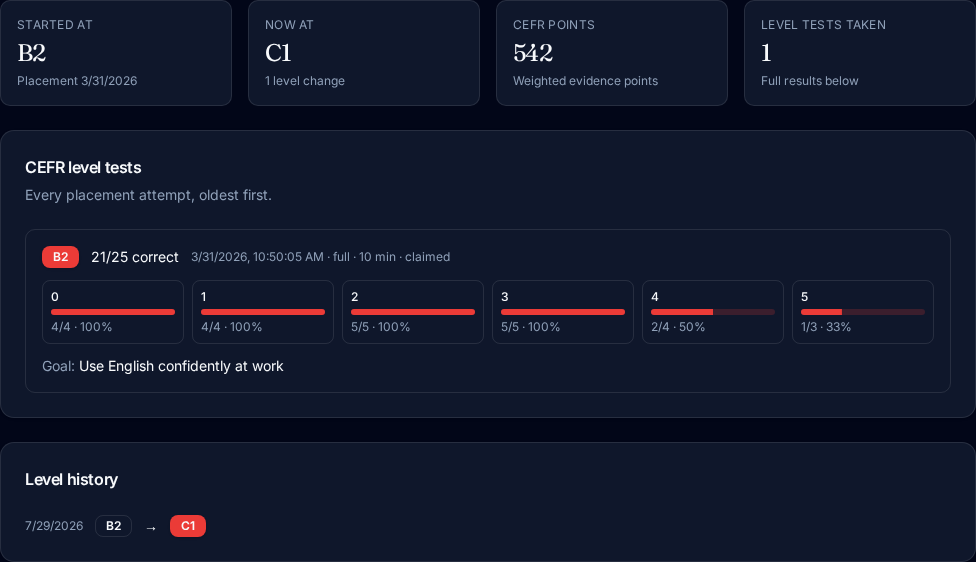
Something to put in the review.
Each person's record shows graded work, scores and level changes with dates, not a self-rating.
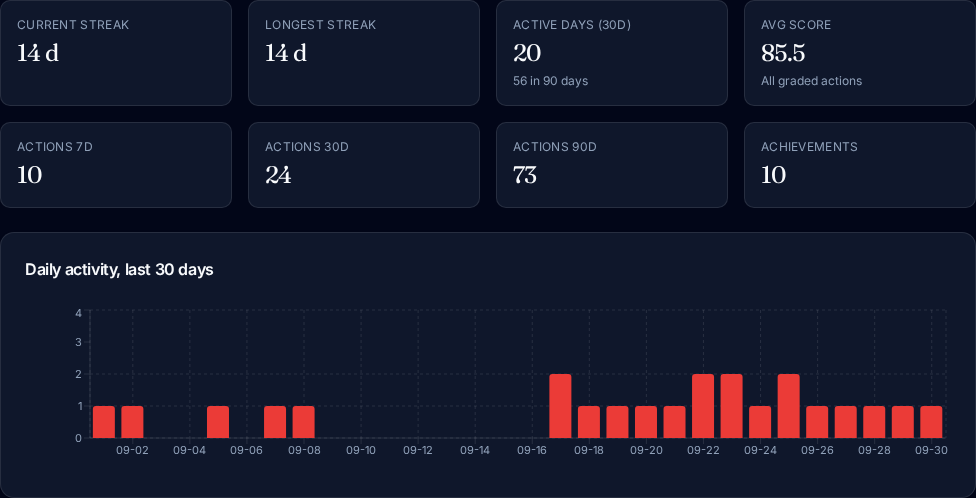
Progress people can see themselves.
Streaks, completion and earned badges keep learning going between reviews, and give you a plain read on who is still active.
Not one AI. Several, chosen by the job.
Most language apps put a single model behind everything they do. We route each call by what it actually has to do: fast, low-cost models handle tagging, translation and clean-up, a stronger everyday model handles anything a learner or teacher reads, and a frontier model is reserved for the few places quality is really judged, such as spoken feedback, lesson building and your personal coaching tips. Speech-to-text, text-to-speech and search run on their own specialist models.
Tagging, translation, extraction and clean-up: the high-volume work nobody reads directly.
Lessons, practice grading, tutor chat and song analysis: everything a learner sees day to day.
Spoken feedback, lesson building from your own material, and the coaching tips drawn from your last 30 days.
- 1. Your answer
Spoken or written work, from a lesson, practice or a tutor chat.
- 2. Your context
Your CEFR level, goals and recent weak skills, read from your own record.
- 3. Teaching knowledge
Curated first-language contrasts, such as Czech vs English, added to the request.
- 4. Private gateway
One secure route to the model chosen for the task. Providers act as our processors.
- 5. Feedback in your language
Scores, the reason behind each correction, and a next step to try.
It is why the feedback reads like a teacher rather than a chatbot: the places that need judgement get a model chosen for judgement, and the places that do not are kept cheap so the first group can stay expensive.
Before a model change reaches learners, we run a fixed set of real speech answers and songs through the current model and the candidate, side by side, and store every run. A change ships because the comparison says it is better, not because a newer name appeared.
Through our secure AI gateway we can access models from Google (Gemini), OpenAI (GPT) and Anthropic (Claude), and we pick per task. Today's features run on Gemini and GPT. We do not publish which model serves which feature, because we re-route calls whenever a better option appears.
Explore LinguaBOOST AI AnalysisNaming our AI providers means answering this.
- Spoken answers, their transcripts and the feedback produced from them are stored in the learner's own record.
- Written work, lesson reflections and coaching tips are stored in the learner's record and visible to the teacher linked to them.
- AI providers process the content sent to them in order to return a result, acting as our processors under their terms.
- Learners and organisations can request an export or deletion of that record at any time.
The full detail of what we collect, why, and your GDPR rights is in our Privacy Policy.
Learn AI. Learn English.
One course, two outcomes.
The only English-language learning platform delivering an EIT Deep Tech Talent Initiative quality-checked AI skills course.
You build real AI skills and your English at the same time, because the course is taught in English. Educators call this CLIL — Content and Language Integrated Learning, the same principle behind an Erasmus placement.
The course content is quality checked by the EIT Deep Tech Talent Initiative, an initiative supported by the European Institute of Innovation and Technology (EIT), a body of the European Union.


- Course
- Agentic AI Agent Building, AI Team Creation and human-AI Team Collaboration Skills
- Certificate no.
- DTTI.2025.11083-546
- Pledger ID
- 6222
- Valid until
- 30 June 2027
- Level
- EQF 4–6
The quality check applies to the course "Agentic AI Agent Building, AI Team Creation and human-AI Team Collaboration Skills" and is valid until 30 June 2027. It is a quality check of the course, not an EU credential awarded to an individual learner, and it is not CEFR certification.
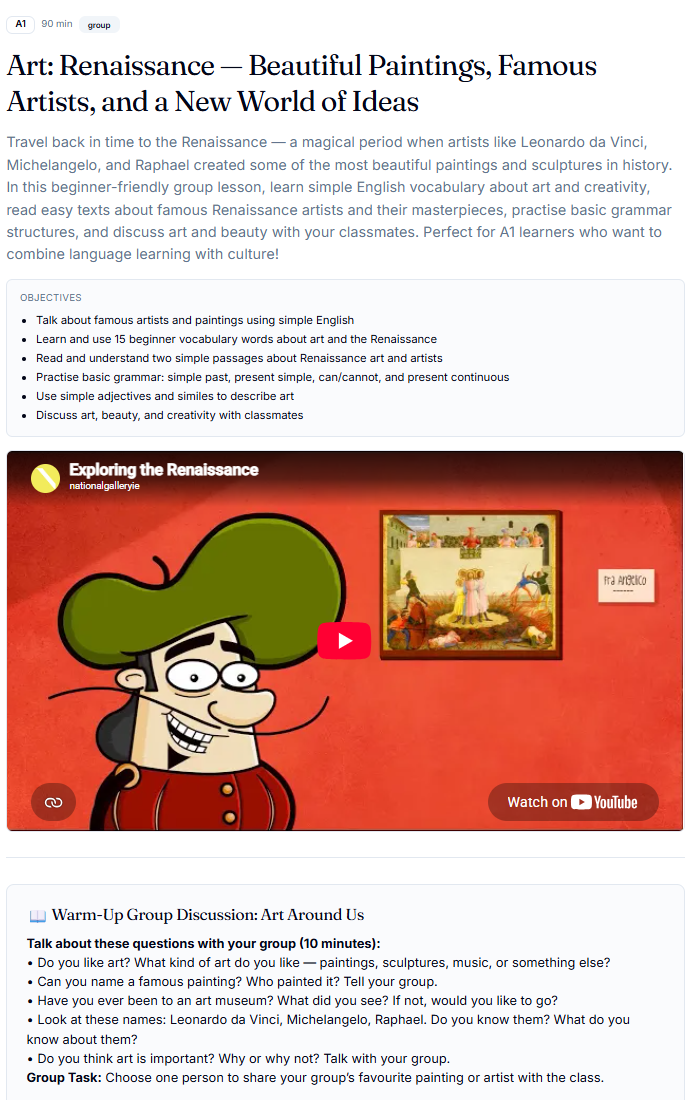
Evidence someone can actually hold a conversation.
People produce real English inside lessons and practice, spoken or written, and every answer is scored on organisation, vocabulary, grammar and content, with corrections and a natural-English rewrite. That is far better hiring and development evidence than a quiz result.
A typical rollout
- 1
Place the group
Everyone takes the CEFR placement test. You get a distribution rather than a set of opinions.
- 2
Set the target band
Decide the level each role needs and enrol the people who are below it.
- 3
Review the movement
Check level changes, speaking scores and graded work per person at your review cadence.
What this is, precisely
- CEFR-aligned levels
- Placement, thresholds and automatic promotion follow the A1–C2 bands and are driven by graded results, not by course completion.
- Auditable by design
- Every graded action writes an append-only event with level, skill and score, so any reported number can be traced back to the work behind it.
- Learner-level detail
- Per-person drill-down covers timeline, error patterns and AI-generated insight on what to work on next.
- Live teacher time available
- Where self-study is not enough, learners can book live video or on-site sessions that are credited to their record.
Reporting covers the learners assigned to your account. CEFR alignment is not certification by an external awarding body, so treat the level as a well-evidenced internal signal, not a substitute for an exam board result where one is legally required.
Download the LinguaBOOST Guarantee
Our 90-day progress guarantee, plus a side-by-side look at the typical old-school approach and LinguaBOOST modern learning. Easy to share with colleagues.
Replace the self-rating.
Start a free 14-day demo account and we will place a small group of your people so you can see the distribution for yourself.